
Hardware Hacking Village
The Hardware Hacking Village is a special area of the conference where attendees can learn about hardware hacking and the basic concepts of electrical engineering, including surface-mount soldering and circuit design. Sponsored by the LA hackerspace, Null Space Labs, there will be volunteers on hand demonstrating how to assemble this year’s badge and a number of other electronics projects. This year’s badges (both attendee and speaker) will be electronic, but you have to assemble them in the hardware hacking village!

At LayerOne we want you to get down and dirty with hardware hacking. Learn how to solder and use the plethora of equipment available! The Hardware Hacking Village has top of the line Metcal soldering irons, ovens, hotplates, solder dispenser syringes with automatic solder paste feeders, thru hole, scopes, meters, power supplies, and more! The Hardware Hacking Village is also the perfect place to plan, assemble, and fix your HeboCon Robot Battle entry!
The Hardware Hacking Village is open from 10:00 – 18:00 Saturday and Sunday.
2025 HHV Schedule
Saturday – May 24, 2025 (All times listed in Pacific time) |
|
|---|---|
| Time |
|
| 10:00 | Village opens! NFC Scavenger Hunt starts The Intercept starts |
| 11:30 | Meow Mixer Soldering (Kit cost $20) – Learn basic soldering with Felix and the Meow Mixer badge. |
| 13:00 | Mehmet Sencan – Self-Destructing Hardware Attacks (lightning talk) |
| 13:30 | Intro to Meshtastic Workshop (Kit cost $30) – Learn basic and advanced setup features for a Meshtastic node with Kody K and the Meshtastic Nibble. |
| 16:30 | Chickenman’s Wi-Fi Duel – Compete against other attendees for prizes! |
| 18:00 | Demo Party in the Hardware Hacking Village |
Sunday – May 25, 2025 (All times listed in Pacific time) |
|
|---|---|
| Time |
|
| 10:00 | Village opens |
| 11:00 | Hebocon Robot Battles starts |
| 14:00 | Wi-Fi Hacking Self Defense (Kit cost $60) – Learn 4 common Wi-Fi hacking techniques and how to protect against them with Kody K and the Wi-Fi Nugget. |
| 16:00 | The Intercept ends. NFC Scavenger Hunt ends. |
2025 Electronic Badge
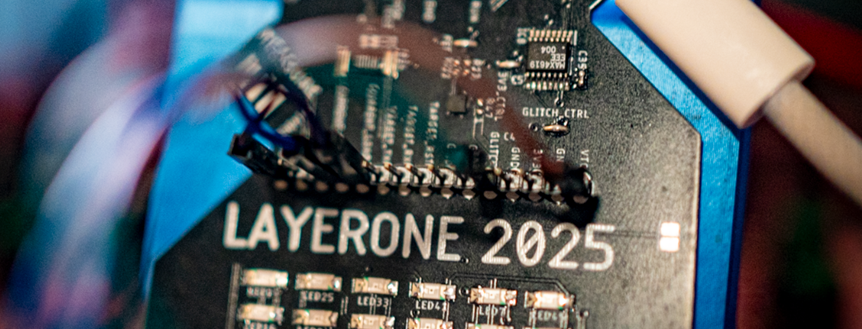
There’s been a glitch. Stack dump coming soon. (*@#(&!)_)#($789@*6y72
2024 Electronic Badge
Details and software at https://github.com/charlie-x/LayerOne_2024
2023 Electronic Badge
Details and software at https://github.com/charlie-x/LayerOne2023
2020-2022 Electronic Badges
Here be ghosts, here be dragons.
2019 Electronic Badge
2019, Los Angeles. There was only One Choice. Read the full badge writeup over on Hackday: Hunting Replicants With The 2019 LayerOne Badge.
2018 Electronic Badge
2017 Electronic Badge
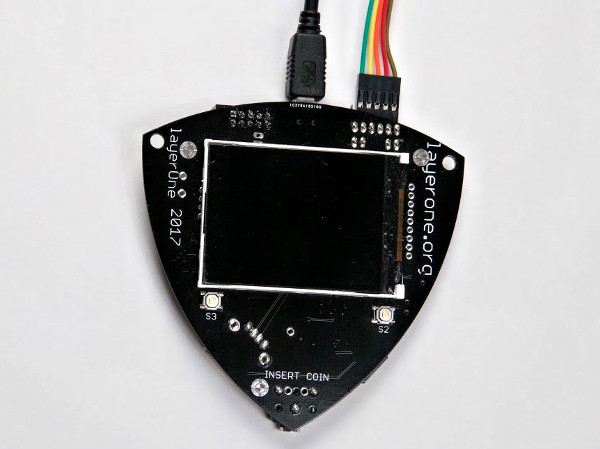
Full build details and the story of the making of the 2017 electronic badge is available on the badge team’s Hackaday.io project page.
2016 Electronic Badge
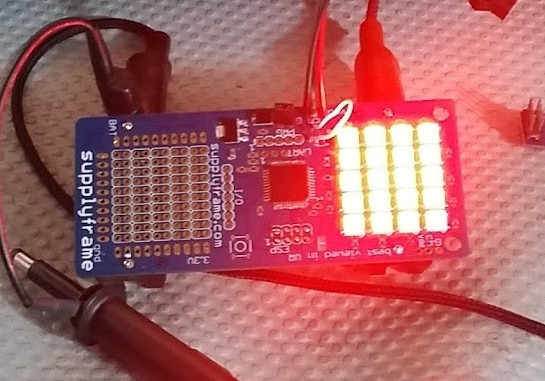
Full build details and the story of the making of the 2016 electronic badge is available on CharlieX’s Hackaday project page.
2015 Electronic Badge
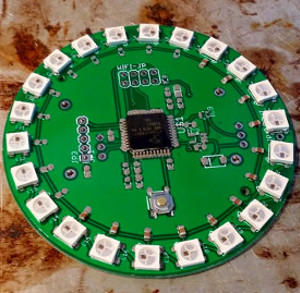
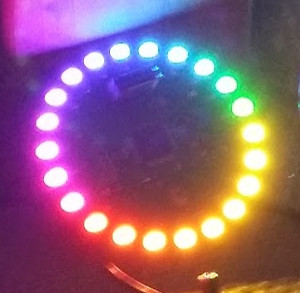
Full build details for both badges, including a wealth of information for badge hacking at CharlieX’s Hackaday project page.
2014 Electronic Badge

Above photo is of the PROTOTYPE VERSION. Full technical details and build notes for the 2014 badge are available on Charliex’s Hackaday project page.
2013 Electronic Badge
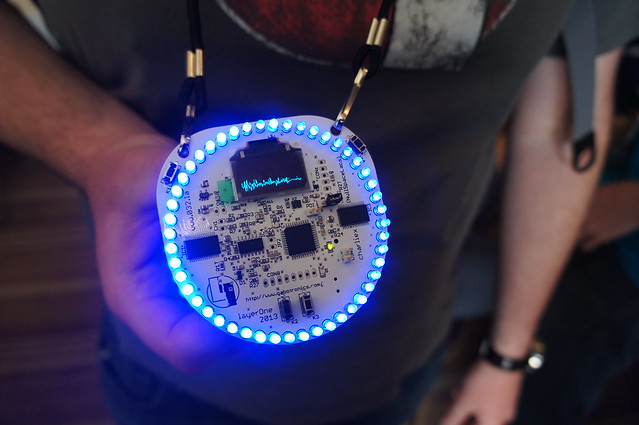
The 2013 badge was designed (once again!) by Charliex of Null Space Labs. A full writeup of the badge design process, features, and components can be found on Charliex’s Blog – L1 2013 Badge. The fully build badge included a ring of LEDs, a small oscilloscope, spectrum analyzer, and a frequency generator.
2012 Electronic Badge
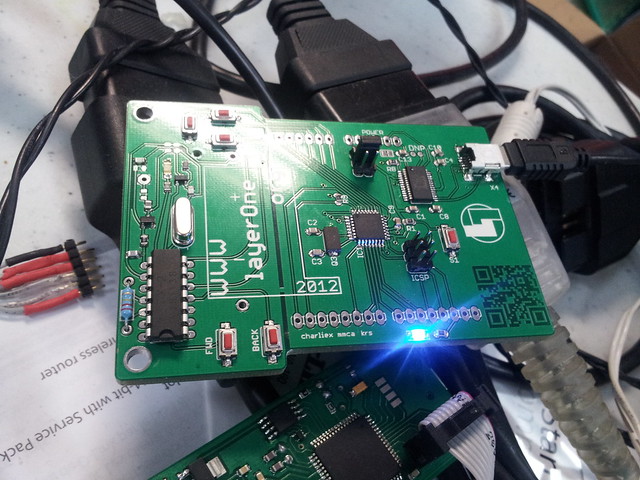
The 2012 badge was designed (again!) by Charliex of Null Space Labs. When fully built it turned into a remote control for RC cars. The speaker version had a secondary add-on board with a 17×10 matrix of LEDs! A full writeup of the design process, features, and components can be found on Charliex’s Blog – Preparing for L1 2012.
2011 Electronic Badge
The 2011 badge was a custom PCB that could be worked on in the Hardware Hacking Village to make a mini synthesizer. Designed by Charliex of Null Space Labs, it is based on the open source meeblip and the AVR Synth. (The meeblip is a reworked version of the AVR synth.) It has a 16 bit output with a DAC that’s loaded 8 bits at a time. To cut down costs and assembly time we used a simple R2R ladder and dropped off the amp stage, since R2R’s pretty much rock.
The design was changed to surface mount and the CPU was switched to the ATMEGA64 or ATMEGA128 for those needing next-level beats and more hackability. The MIDI interface is on a seperate mini PCB that connects to the badge so you can play Rockband’s pro keyboard or guitar. The pots were changed to linear slide and the switches to momentary to save cost and space. Our intial meeblip version we reworked at NSL worked out about half the cost of the original — this one is even less than that. Both ISP and JTAG are broken out, since the ATMEGA64/128 is one of the bastard children of the ATMEL series. Finally, 20 charlieplexed LED’s were added because blinky things are a must have at any premier security conference.
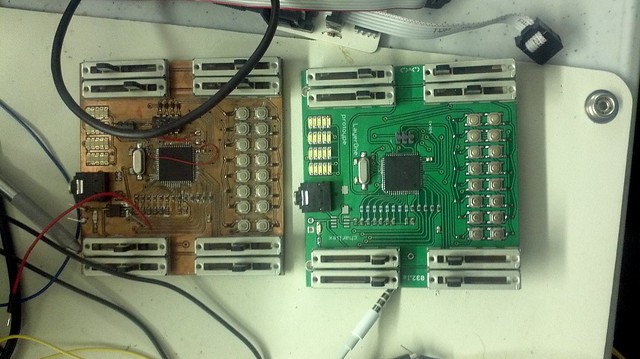
Prototypes of the LayerOne 2011 attendee badge.
Speakers had their own 4-layer PCB badges designed by Krs, who is also gave a short talk on their design and her experiences going from EE newbie to designing complex PCBs in less than a year.
Other electronics projects
A number of volunteers will be around to help you learn how to put these things together and teach you about the underlying concepts of these devices. Some of the projects offered will be the NSL Cylon, a small blinky LED keychain; the AnnaLogic, a logic analyzer; and the TVbNull, a reduced-size, surface mount version of the TVbGone device.
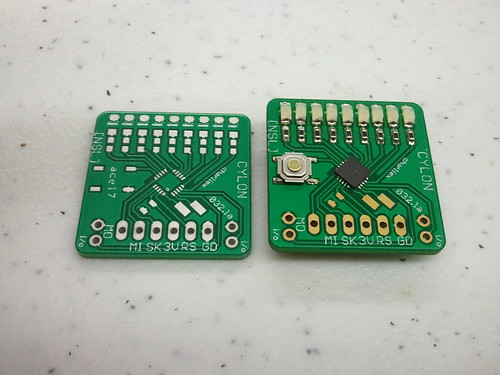
The NSL Cylon
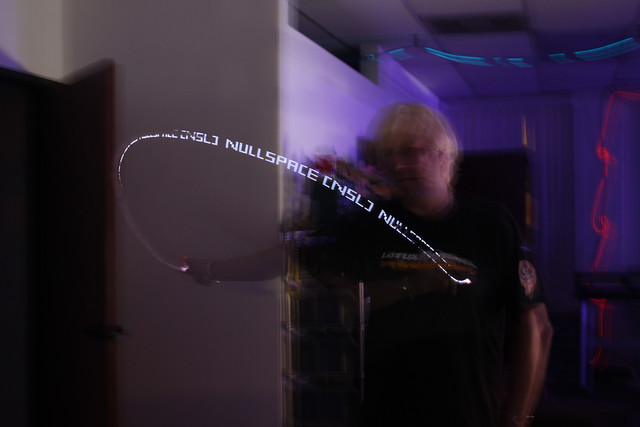
NSL Cylon in POV mode
(^Top)